

Guides · Buying
Orangeburg pipe: what to do when the scope finds it
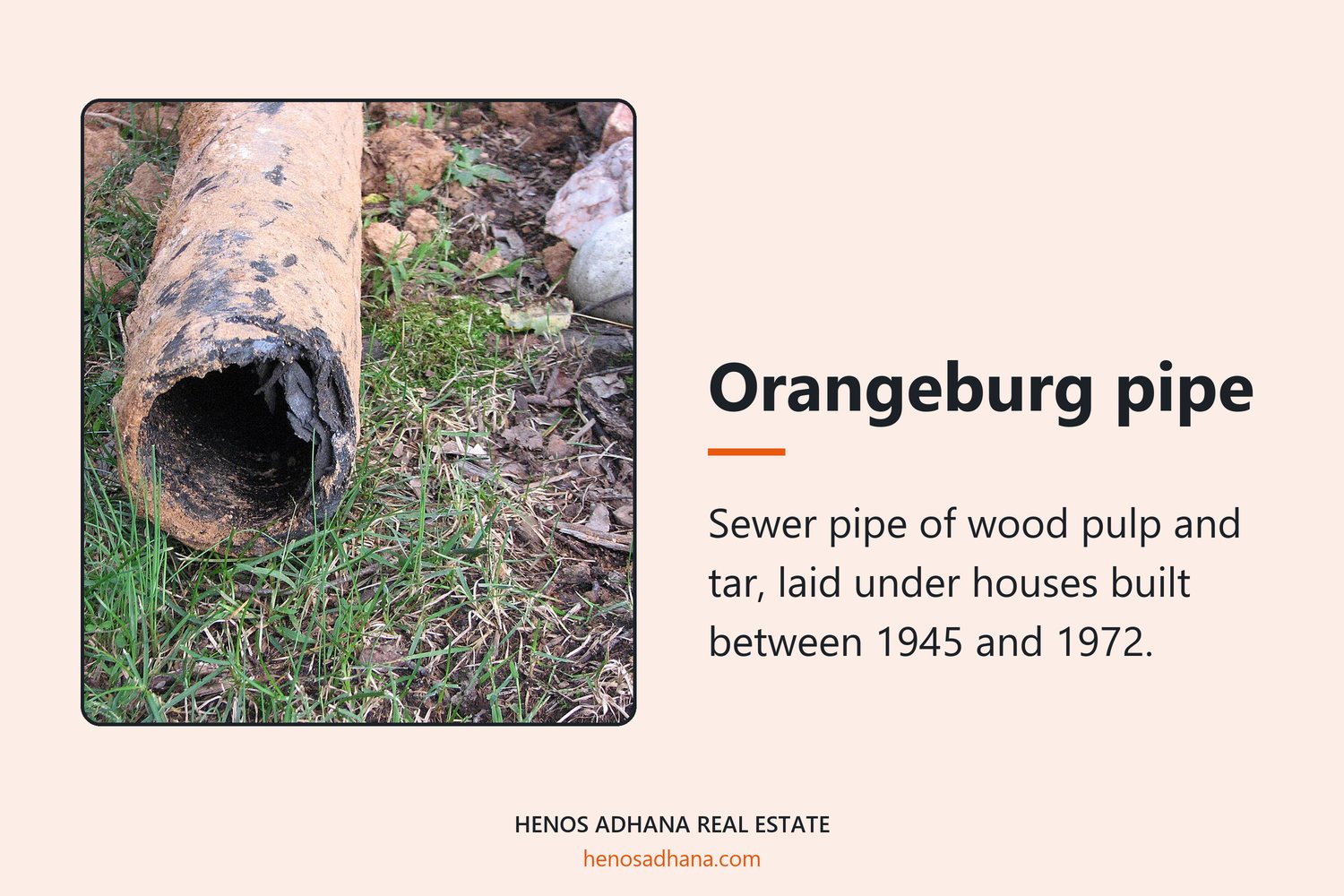
Orangeburg is sewer pipe made from wood pulp bound with coal tar pitch, laid under houses built roughly between 1945 and 1972. It does not crack like clay or rust like iron. It absorbs water, softens, and slowly goes oval until it closes. If a scope finds it, plan on replacing the line rather than repairing it, get the bids while your inspection contingency is still alive, and pull the side sewer card to find out how long the run is, because in Seattle the whole length to the main is yours.
What Orangeburg pipe is#
What it actually is#
It is not a brand of plastic and it is not metal. Orangeburg is wood pulp sealed with liquefied coal tar pitch, made in diameters from two to eighteen inches. The joints were the same material, and they held because the tar stayed tacky.
It exists because of the war. Iron and steel were going to the war effort, so a cheap fibre pipe took their place, and it stayed in use long after the shortage ended. It was made largely in Orangeburg, New York, which is where the name comes from, and the plant there closed in the autumn of 1972 once PVC and ABS had taken over.
The years that matter to a buyer are roughly 1945 to 1972. A Seattle house built in that window, on its original sewer line, is the one to scope before you remove a contingency.
Sources
- Orangeburg pipe, Wikipedia, for the manufacturing history
Have an address in mind already?
Book a call and I'll tell you what I'd doWhy it fails differently from everything else#
Clay cracks. Cast iron rusts and scales. Concrete erodes. Those failures tend to be local: one bad joint, one cracked section, one spot repair.
Orangeburg does something else. It takes on water, the pitch binder gives up, and the weight of the ground above presses a round pipe into an oval. The oval narrows. Roots find the soft seams. Eventually the shape closes altogether.
That is why a patch is usually the wrong answer. The problem is not one spot, it is the material, and the rest of the run is the same age and under the same load. A spot repair on an Orangeburg line buys time, not a solution, and the time it buys is hard to predict.
It also explains why these lines often behave for years and then fail suddenly. Nothing leaks until the shape closes, and then everything backs up at once.
Finding out whether this house has it#
Age is the flag, not the answer. Plenty of houses from that era were re-piped decades ago, and plenty of houses outside it have their own problems.
Two things tell you. The first is the side sewer card, Seattle's record of what was permitted and installed, which also shows you how far the line runs and whether it is shared. The second is a camera scope, which is the only thing that shows the pipe as it is today rather than as it was drawn.
How to read the card, book the scope and work out who owns which part of the line is its own guide, and it is the one to read alongside this.
Order the scope early. It is the inspection that most often changes a price, and it is the one buyers most often leave until the end of the contingency period, when there is no time left to get bids.
Sources
- Side Sewer Cards and Map, Seattle Public Utilities
- Your side sewer, Seattle Public Utilities
Reading the report without panicking#
A scope report on an old line will use words that sound worse than they are, and some that sound milder than they are.
Deflection or ovality is the one that matters on Orangeburg: it is the measure of how far from round the pipe has gone. A line described as deflected is on its way to closing, whatever else the report says.
Offset joints, bellies and root intrusion are common on any old line and are not specific to this material. On Orangeburg they tend to appear together, because the soft pipe moves.
What you want from the inspector, in writing, is three things: the material, the depth and length of the run, and whether the line is shared with a neighbour. Those three decide what the fix costs far more than the severity language does.
What the fix looks like#
There are three broad routes, and the pipe's condition decides which are actually available.
Full replacement by open trench. Dig the line out and lay new pipe. The cost is driven by length, depth and what is on top: a lawn is cheap, a mature garden less so, a driveway or a city street more again.
Pipe bursting, a trenchless method that pulls a new pipe through while breaking the old one outward. Less digging, usually two access pits rather than a trench, and often the cheaper answer on a long run under hard surfaces.
Lining, where a resin sleeve is cured inside the existing pipe. This is the one to ask hard questions about on Orangeburg, because a liner needs a host pipe with enough shape left to line against. On a badly deflected fibre pipe there may not be one.
Get two bids, not one, and get them before the contingency expires. The spread between contractors on the same run is wide, and a single number is not a negotiating position. Ask each one whether a city Street Use permit is needed for the portion in the right of way, because that changes both the price and the timeline.
Who pays for it#
This is a negotiation, not a rule, and the answer depends on how the house is priced and how much competition there is for it.
In practice there are three ways it lands. The seller fixes it before closing, which is slowest and gives you least control over who does the work. The seller credits you at closing and you do it afterwards, which is usually cleaner. Or the price comes down and you take the problem on knowingly.
How seller credits work, and the limit your lender puts on them matters here, because a credit larger than the cap simply will not fund.
One thing to check before you argue: whether the seller already knew. A line that has been backing up gets disclosed on Form 17, and a seller who knew and did not say has a different problem than one who genuinely did not.
If you are the one selling#
Scope the line before you list, not after you are under contract. A scope you commission is information. A scope the buyer commissions on day eight of a ten-day contingency is leverage.
If it comes back bad, you have a real choice: fix it and sell a house with a new sewer line, or price it in and say so plainly up front. Both work. What does not work is finding out at the same moment the buyer does.
Either way it goes on the disclosure. A known sewer problem is exactly the sort of thing Form 17 asks about, and the cost of not mentioning it is far higher than the cost of the pipe.
Common questions#
What is Orangeburg pipe?
Sewer pipe made from wood pulp bound with coal tar pitch, made in diameters from two to eighteen inches. It was widely installed in houses built between about 1945 and 1972, after wartime shortages pushed iron and steel out of residential sewer work.
How do I know if my house has it?
The year built tells you whether it is possible, roughly 1945 to 1972. Only two things tell you for certain: Seattle's side sewer card, which records what was permitted and installed, and a camera scope, which shows the pipe as it is now.
How long does Orangeburg pipe last?
It was sold as a long-life product and in practice many lines began deforming decades ago. Every one still in the ground is well past the age at which the material starts to lose its shape, which is why age alone is not reassuring.
Can Orangeburg pipe be lined instead of replaced?
Sometimes, but it is the right question to ask hard. A cured-in-place liner needs a host pipe with enough shape left to line against, and a badly deflected fibre pipe may not have one. Ask the contractor to tell you what the scope shows before quoting a liner.
Is Orangeburg pipe a dealbreaker?
No. It is a cost, and costs are negotiable. What makes it a dealbreaker is discovering it with two days left on the inspection contingency and no bids in hand, because then the only options are guessing or walking.
Does homeowners insurance cover a collapsed sewer line?
Usually not for the pipe itself, which is treated as wear rather than a sudden loss, though some policies add a service line endorsement. Read the endorsement rather than assuming, and ask your agent before you need it.
Who owns the sewer line in Seattle, me or the city?
In Seattle the side sewer is the property owner's responsibility for its whole length, including the part under the street out to the main. That is why the length of the run matters so much to the cost.
Should I still buy a house with Orangeburg?
Plenty of people do. Price the replacement with two real bids, decide who is paying for it as part of the negotiation, and go in knowing the number. The houses that hurt people are the ones where nobody scoped the line.