

Guides · Buying and selling
Closing costs in Washington: who pays what, and how much it comes to
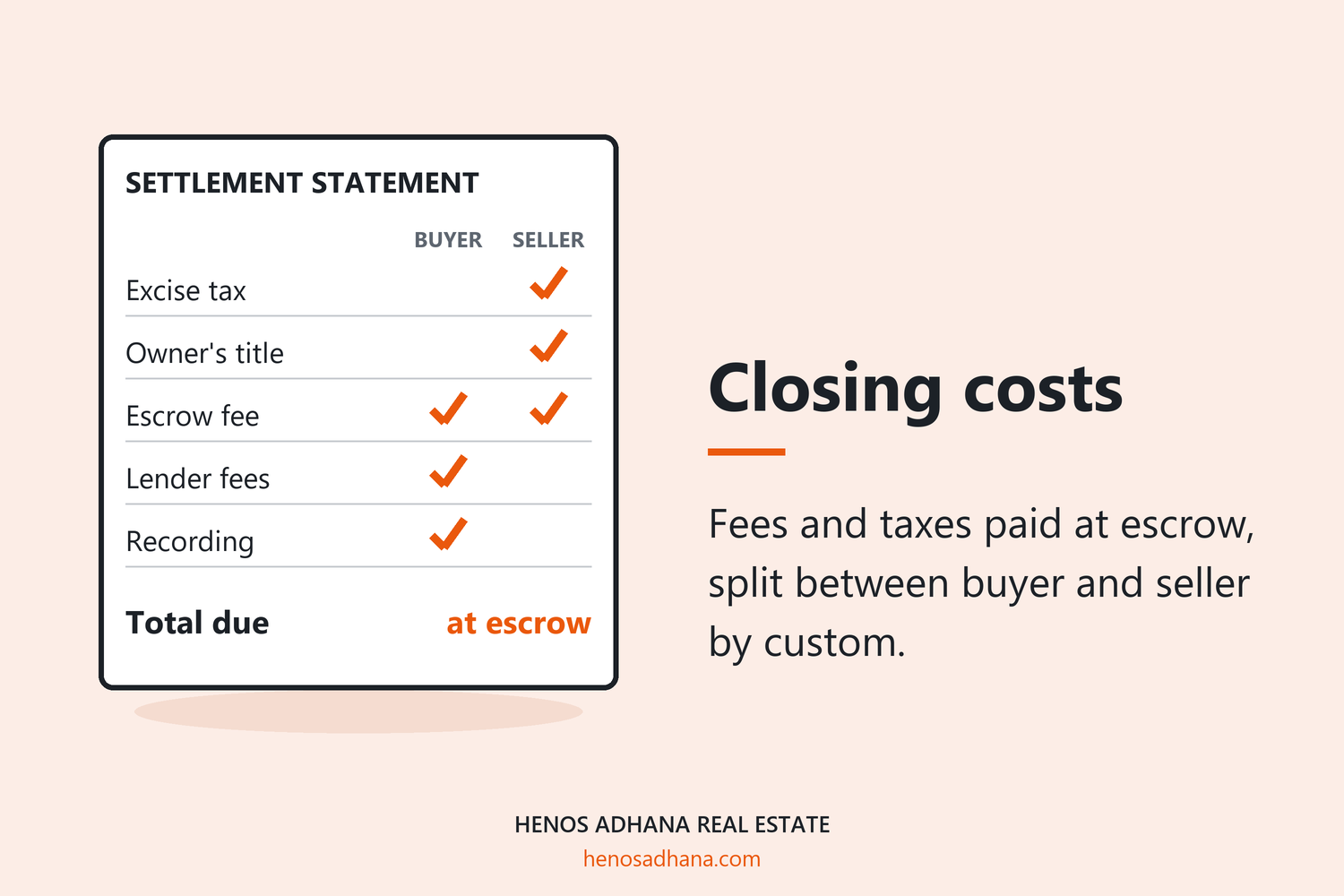
In Washington the buyer and the seller each pay closing costs, split by custom rather than by law. The seller pays the excise tax, the standard owner's title policy and half the escrow fee. The buyer pays the lender's charges, the lender's title policy, recording, prepaids and the other half. Worked for an $850,000 Seattle house below, that comes to about $19,300 for the seller before commission, and about $13,800 for a buyer putting 20% down, before any points.
Who pays what at closing#
Who pays what, by Washington custom#
No Washington law says who pays which closing cost. Custom does, and the purchase agreement can move most of it. This is the usual split on a resale.
The seller usually pays
- Real estate excise tax, by far the largest item. Worked to the dollar here.
- The owner's title policy, at standard coverage. It protects the buyer.
- Half the escrow fee.
- Paying off their loan, plus the fees to release it on the county record.
- Their share of property tax and HOA dues, up to the day of closing.
- Commission, as the listing agreement says. Who pays the buyer's agent is now a separate negotiation.
- A condo's resale certificate, which the association can charge up to $275 for.
The buyer usually pays
- The lender's charges: origination, underwriting, the appraisal and the credit report.
- The lender's title policy, plus the difference if you upgrade the owner's policy to the broader homeowner's version.
- Half the escrow fee.
- Recording the deed and the deed of trust with the county.
- Prepaids: interest to the end of the month, the first year of insurance, and the property tax your lender holds in reserve.
- The inspection, which you pay when you book it, before closing.
A seller credit is the usual way to move part of the buyer's column across. How they work, and the loan limits on them.
Sources
- Real estate laws and customs: Washington, Fidelity National Title
Wondering what this means for your budget?
Book a 30-minute buying callThe seller's side, worked for an $850,000 Seattle house#
A 2026 sale, using CW Title's published King County rates for title and escrow and the county's own recording fee. Title companies publish their own rates, so treat these as a close reference rather than a quote.
One detail the averages miss: Washington charges sales tax on title insurance and escrow fees, and Seattle's rate has been 10.55% since 1 January 2026.
| Cost | Amount |
|---|---|
| Real estate excise tax$9,935 to the state and $4,250 to Seattle, plus the state's $5 technology fee | $14,190 |
| Owner's title policy, standard coverage$2,318 plus sales tax. $1,855 before tax if the house was insured by an owner's policy in the last ten years | $2,563 |
| Half the escrow fee$1,525, plus a $95 charge per side for wires and deliveries, plus sales tax | $1,791 |
| Releasing the seller's loanThe escrow company's $450 reconveyance fee plus tax, and $303.50 to record the release | $801 |
| Before commission and prorationsAbout 2.3% of the price. The excise tax is almost three quarters of it | $19,345 |
Commission comes on top, at whatever the listing agreement says, along with the seller's share of this year's property tax and dues, and any credit agreed with the buyer. Escrow takes all of it out of the proceeds, so most sellers never write a check for any of it.
Sources
- Residential escrow fee schedule, effective 9 February 2026, CW Title and Escrow
- Residential purchase title rates, King, Snohomish and Pierce, effective 1 February 2024, CW Title and Escrow
- Recording fees, King County Recorder's Office
- WAC 458-20-156, abstract, title insurance and escrow businesses, Washington State Legislature
- Seattle local sales tax change, effective 1 January 2026, Washington State Department of Revenue
- Real estate excise tax, including the technology fee, Washington State Department of Revenue
The buyer's side, with 20% down#
The same house, with $170,000 down and a $680,000 conventional loan at 6.5%. The first three rows are published rates. The rest depend on your lender, your insurer and the day you close, so the notes say where a figure is an assumption.
| Cost | Amount |
|---|---|
| Half the escrow feeThe same as the seller's half | $1,791 |
| Lender's title policy$1,016 plus sales tax, for extended coverage issued alongside the seller's owner's policy | $1,123 |
| Recording the deed and deed of trustAbout. King County charges $303.50 for the deed and $304.50 for the deed of trust, plus $1 for each page after the first | $630 |
| Lender's charges and the appraisalAssumed, with no points: origination, underwriting, appraisal and credit report | $3,500 |
| Prepaid interest15 days at $121.10 a day, for a closing in the middle of the month | $1,816 |
| First year of homeowners insuranceAssumed. Get quotes as soon as you are under contract | $1,800 |
| Opening your escrow accountAssumed four months of property tax and two of insurance. At Seattle's 2026 levy rate of $9.91 per $1,000, the tax here is about $8,420 a year | $3,107 |
| Total, before any pointsAbout 1.6% of the price. The fees are about half of it; the rest is interest, insurance and tax paid in advance | $13,767 |
Points are the big swing. More than half of 2023 home purchase loans paid some, and the median was $3,000, according to the CFPB. That alone would take this example to about $16,800.
So is the month you close. Your lender sizes the escrow account to the next tax due date, which in King County is April 30 or October 31, so it can hold more or less than four months.
That is why I budget $15,000 to $30,000 for a typical Seattle purchase, and why the number to trust is the one on your own Loan Estimate.
Not in the table: the down payment, which is not a closing cost, and your earnest money, which is credited back to you at closing. The inspection and a sewer scope are paid when you book them, not at closing. Upgrading the owner's policy to the broader homeowner's version costs you the difference, $232 before tax at this price.
Sources
- 2023 mortgage market activity and trends, Consumer Financial Protection Bureau
- City tax comparisons 2025 to 2026, Seattle, King County Assessor
- Property tax frequently asked questions, King County Treasury
Why the numbers online disagree#
Search this and you will find anything from under 2% of the price to 5%. Most of the gap is in what gets counted.
Prepaids. Interest, insurance and the tax reserve are about half the buyer's total above. Some averages leave them out. The Closing Disclosure counts them, so this page does too.
Commission. On the seller's side it is often the largest number of all, and some estimates fold it in. I keep it separate, because it is negotiated rather than customary.
Price. Several costs barely move with the price. CW Title's half of the escrow fee is $1,300 on a $450,000 condo and $1,525 on this house, and the recording fees are the same for both. So the cheaper the home, the bigger the share of the price its closing costs take.
Age. Rates change. Seattle's sales tax rose in January, and the state's excise tax bands move again on 1 January 2027.
The two documents that give you your real number#
The Loan Estimate. A lender must give you one within three business days of your application. Every lender uses the same form, so two can be laid side by side. Its costs are split in two: loan costs, which are the lender's charges and the services it requires, and other costs, which are taxes, recording, prepaids and the escrow account.
Compare the loan costs between lenders. For context, the median home buyer's loan costs, title and settlement services included, were $6,684 nationally in 2023, according to the CFPB. The other costs belong to the house and will be much the same wherever you borrow.
The Closing Disclosure. It replaces the estimates with final numbers, and your lender must get it to you three business days before closing. Check it against your Loan Estimate line by line. Federal rules limit how far most charges can rise between the two, so ask about anything that moved.
Sellers get their numbers from escrow, as an estimated settlement statement. Ask for one early: it is where your net figure really comes from.
Sources
- Loan Estimate explainer, Consumer Financial Protection Bureau
- Closing Disclosure explainer, Consumer Financial Protection Bureau
Ways to bring less to closing#
Ask for a seller credit. It is the most direct: the seller pays part of your costs, within your loan's limit. How much your loan allows.
Take a lender credit. A lender will often pay part of your costs in exchange for a slightly higher rate. It is buying points in reverse, and it suits you if you expect to sell or refinance within a few years.
Check the state's assistance. Washington's Home Advantage down payment assistance can cover closing costs as well as the down payment. What the state programs offer.
Pick the closing date with care. Closing late in the month cuts the prepaid interest, but your first payment then arrives sooner. It moves money rather than saving it, which is still useful when cash at closing is the tight part.
If you are selling, three things to check#
The short-term title rate. On CW Title's card, a house insured by an owner's policy in the last ten years gets a cheaper new one: $1,855 instead of $2,318 at this price. If you bought within ten years, make sure your estimate uses it.
Property tax you have already paid. Washington's property tax year is the calendar year, paid in halves due April 30 and October 31. If you have paid a half and close before it runs out, the buyer pays you back the rest at closing, worked out by the day.
The condo's resale certificate. Washington law gives the association ten days to produce it and lets it charge up to $275, so order it when you list rather than when an offer arrives.
Sources
- RCW 64.90.640, resale of units, Washington State Legislature
Common questions#
Who pays closing costs in Washington state?
Both sides, by custom. The seller usually pays the excise tax, the standard owner's title policy and half the escrow fee. The buyer pays the lender's charges, the lender's title policy, recording, prepaids and the other half. The purchase agreement can move most of it.
How much are closing costs in Washington?
On an $850,000 Seattle house, about $19,300 for the seller before commission, and about $13,800 for a buyer with 20% down before any points. Most of the seller's figure is excise tax. About half the buyer's is prepaid interest, insurance and tax.
What closing costs does a seller pay in Washington?
The real estate excise tax, the standard owner's title policy, half the escrow fee, the cost of releasing their loan, and their share of property tax and dues up to closing. Commission comes on top, as agreed in the listing.
Can the seller pay the buyer's closing costs?
Yes, if it is agreed in writing as a seller credit. The buyer's loan sets the limit: 3% to 9% of the price on a conventional loan, depending on the down payment, and 6% on FHA.
Is there sales tax on title insurance and escrow in Washington?
Yes. Washington charges retail sales tax on title insurance premiums and escrow fees. In Seattle the rate has been 10.55% since 1 January 2026.
When will I know my exact closing costs?
Your Loan Estimate, due within three business days of applying, gives the first detailed figure. The Closing Disclosure gives the final one, three business days before closing. Sellers get an estimated settlement statement from escrow.