
Ravenna market snapshot
Over the trailing twelve months, the median Ravenna home sold for about $1,112,500, up 0.1% from a year earlier. Homes here typically went under contract in about 7 days at roughly 100.0% of list price (around $561/sq ft), reflecting a brisk, seller-leaning market. These rolling 12-month figures come from the Northwest Multiple Listing Service, the regional MLS Seattle-area agents list on, as of June 2026, and cover the broader market area around Ravenna rather than Ravenna on its own, so for any specific home it is worth comparing recent sales on that block.
About Ravenna
Ravenna is a residential neighborhood in northeastern Seattle, named after Ravenna, Italy, and platted in the 1890s by developer William Wirt Beck. It was incorporated as a town in 1906 and annexed by Seattle the following year. The neighborhood sits north of the University District and is generally bounded by Roosevelt to the west, Maple Leaf and Wedgwood to the north, and View Ridge and Laurelhurst to the east.
Much of Ravenna is a mature, low-density area organized around Ravenna Park, the connected Cowen Park, and the diagonal Ravenna Boulevard, which the Olmsted Brothers folded into Seattle's citywide parks-and-boulevards plan in 1903. As a buyer or seller here, you are working in an established market where much of the land was developed decades ago and new supply comes largely from remodels and infill rather than large new subdivisions.
Want to know what your money actually buys in Ravenna right now?
Book a 30-minute buying callHousing & homes
Ravenna's housing is dominated by early-twentieth-century single-family homes. In the Ravenna-Cowen North Historic District, listed on the National Register of Historic Places in 2018, most homes were built before the early 1930s, with Craftsman, Tudor Revival, and Colonial Revival styles well represented. Post-World War II additions in the broader neighborhood include Minimal Traditional cottages and Pacific Northwest contemporary houses.
Beyond detached houses, the housing mix widens toward the south and west edges near the University District, where townhomes, older apartment buildings, and condominiums appear closer to arterials and the University Village shopping district. Lots vary from compact in-town parcels to larger sites along and above the ravine, so it is worth confirming zoning, setbacks, and any historic-district considerations before planning additions or a rebuild.
Local conditions to know
The defining physical feature is the Ravenna ravine, which reaches a maximum depth of roughly 115 feet and carries Ravenna Creek through Ravenna and Cowen parks. Parcels near the ravine can fall within Seattle's Environmentally Critical Areas framework, which regulates steep slopes (generally 40 percent or more), landslide-prone ground, and erosion; the city also maps liquefaction-prone soils across Seattle. If a property borders the ravine or sits on filled or sloping ground, expect additional review and geotechnical questions during permitting, and verify designations through Seattle SDCI before you build.
Ravenna is well positioned for transit. Sound Transit's Link light rail opened underground stations at U District and Roosevelt in 2021, both within reach of the neighborhood's south and west sides, connecting riders toward downtown, the University of Washington, and Northgate. The neighborhood is not on the immediate shoreline of Lake Washington or Puget Sound, so tidal and waterfront-flood considerations are limited compared with lakeside areas.
Getting around & local texture
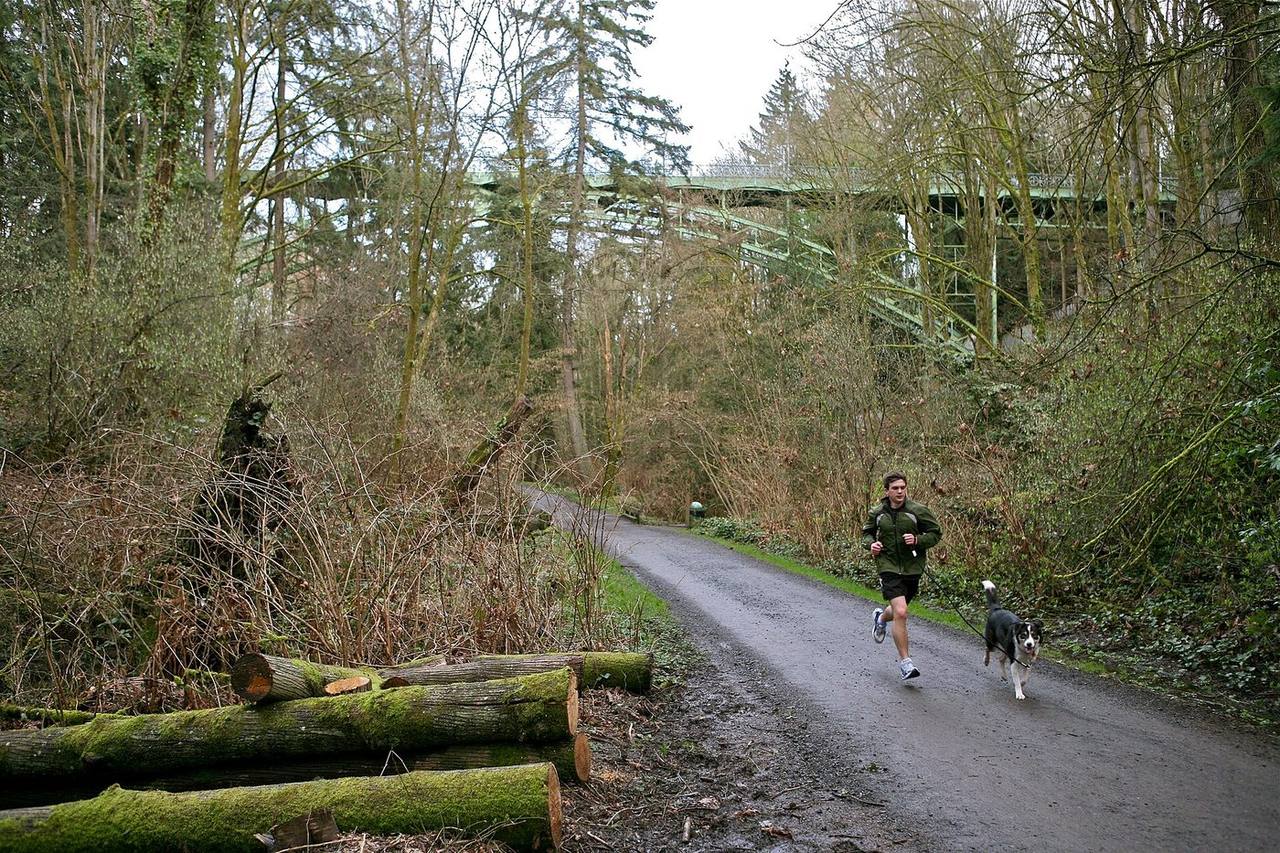
Ravenna and Cowen parks form the neighborhood's green spine, with trails through the ravine, a wading pool, ballfields, and play areas, plus two historic bridges: the Cowen Park Bridge on 15th Avenue NE and the 20th Avenue NE (Ravenna Park) Bridge, which has been closed to vehicles since 1975. A section of Ravenna Creek near the park's southeastern end was daylighted in 2006, restoring open flow. Ravenna Boulevard remains a landmark Olmsted greenway.
Commercial activity clusters at the south end, where University Village, an open-air shopping center that opened in 1956 in the south corner of Ravenna, anchors retail and dining; smaller business nodes run along arterials such as NE 65th Street. Public-school students in this area are served by Seattle Public Schools; the local attendance-area elementary is Bryant Elementary, at 3311 NE 60th Street. Confirm current attendance boundaries with the district's official maps and address lookup, since Seattle Public Schools periodically revises them.
What buyers & sellers weigh in Ravenna
- If a home lies in the Ravenna-Cowen North Historic District, ask early about the review process for exterior changes and additions.
- Parcels near the ravine may trigger Seattle's Environmentally Critical Areas rules for steep slopes, landslide risk, or erosion; budget time for geotechnical review.
- Verify liquefaction and soil designations through Seattle SDCI, especially on sloping or filled lots.
- Proximity to U District and Roosevelt light rail stations differs sharply across the neighborhood; check walk distance for any specific address.
- Older housing stock often means questions about foundations, knob-and-tube wiring, oil tanks, and sewer lines worth inspecting.
- The south and west edges near University Village carry more traffic and a denser housing mix than the interior blocks.
- Confirm the current Seattle Public Schools attendance boundary by address rather than relying on neighborhood reputation.
What makes Ravenna distinct
- A designated National Register historic district (Ravenna-Cowen North) sets Ravenna apart from most surrounding neighborhoods.
- The Ravenna ravine and connected Ravenna-Cowen parks give the area a dramatic natural greenbelt uncommon at this scale in the city.
- Ravenna Boulevard is a signature Olmsted diagonal greenway woven through the residential grid.
- University Village places a major open-air retail destination directly at the neighborhood's south edge.
- Two light rail stations (U District and Roosevelt) opened nearby in 2021, changing transit access to the area.
Services in Ravenna
Ravenna real estate FAQ
What kinds of homes are most common in Ravenna?
Ravenna is dominated by early-twentieth-century single-family houses, with Craftsman, Tudor Revival, and Colonial Revival styles common, especially in the Ravenna-Cowen North Historic District where most homes predate the early 1930s. Townhomes, condominiums, and older apartments appear more toward the University District and University Village edges.
Is Ravenna served by light rail?
Sound Transit opened underground Link light rail stations at U District and Roosevelt in 2021, both reachable from Ravenna's south and west sides. They connect toward downtown Seattle, the University of Washington, and Northgate. Walk distance varies significantly by address.
What should I check about the Ravenna ravine before buying near it?
Properties near the ravine may fall under Seattle's Environmentally Critical Areas rules covering steep slopes, landslide-prone ground, and erosion, and the city also maps liquefaction-prone soils. Confirm designations through Seattle SDCI and consider geotechnical review before planning additions or a rebuild.
Which school district serves Ravenna?
Ravenna is within Seattle Public Schools. The local attendance-area elementary is Bryant Elementary at 3311 NE 60th Street, but boundaries change periodically, so verify the assignment for a specific address using the district's official maps and address lookup.
Sources & data
- Ravenna, Seattle - Wikipedia
- Ravenna-Cowen North Historic District - Wikipedia
- Ravenna Park (Seattle) - Wikipedia
- Ravenna Park - Seattle Parks and Recreation
- Cowen Park - Seattle Parks and Recreation
- Environmentally Critical Areas (ECA) Code - Seattle SDCI
- U District Station - Sound Transit
- Roosevelt station (Sound Transit) - Wikipedia
- University Village, Seattle - Wikipedia
- Bryant Elementary - Seattle Public Schools
- Seattle Public Schools - Enrollment Maps