

Phinney Ridge market snapshot
Over the trailing twelve months, the median Phinney Ridge home sold for about $980,000, up 2.1% from a year earlier. Homes here typically went under contract in about 7 days at roughly 100.0% of list price (around $571/sq ft), reflecting a brisk, seller-leaning market. These rolling 12-month figures come from the Northwest Multiple Listing Service, the regional MLS Seattle-area agents list on, as of June 2026, and cover the broader market area around Phinney Ridge rather than Phinney Ridge on its own, so for any specific home it is worth comparing recent sales on that block.
About Phinney Ridge
Phinney Ridge is a residential neighborhood in north-central Seattle, named for the ridge that runs north and south between Ballard and Green Lake. Its rough boundaries are Aurora Avenue N (State Route 99) on the east, N 75th Street on the north, 8th Avenue NW on the west, and N 50th and Market Streets on the south, where the neighborhood meets Fremont and Wallingford.
The neighborhood takes its name from Guy C. Phinney, a lumber mill owner and real estate developer whose estate the city purchased and turned into Woodland Park in 1899. Streetcar service reached the ridge in the early 1900s, and much of the surrounding North End was platted and built out in that streetcar-suburb era. If you are buying or selling here, Henos Adhana of Henos Adhana Real Estate (HARE), a broker with eXp Realty, can walk you through how the area's history shapes today's homes and lots.
Want to know what your money actually buys in Phinney Ridge right now?
Book a 30-minute buying callHousing & homes
Phinney Ridge developed largely during Seattle's early streetcar expansion, and it retains many houses from the roughly 1900 to 1915 period. The Craftsman bungalow, built widely across North Seattle between about 1900 and 1930, is a common style, characterized by low-pitched gable or hipped roofs, wide eaves, exposed rafters, and front porches. You will also find later 20th-century houses and, along the corridors, some newer townhomes and multifamily construction.
Because so much of the stock predates modern codes, buyers frequently encounter older systems, foundations, and finishes, while sellers often benefit from period detail that many buyers seek. Home inspections, sewer-line scoping, and questions about prior electrical and seismic updates are worth prioritizing on homes of this age.
Local conditions to know
Phinney Ridge sits on a north-south ridge, and higher-elevation ground in Seattle is generally composed of glacial till, which the city's mapping associates with lower liquefaction hazard than low-lying fill areas. The western slope, however, is steep in places; one block of 60th Street NW between 2nd and 3rd Avenues NW has an approximately 28 percent grade. Steeply sloped parcels can fall within Seattle's Environmentally Critical Areas regulations, so it is worth checking a specific address against the city's ECA and geologic-hazard maps before you buy or list.
Aurora Avenue N (SR 99) forms the eastern edge of the neighborhood, which can mean traffic noise on the easternmost blocks. Because the ridge is elevated and away from major water bodies, most of the neighborhood is outside high-risk FEMA flood zones, but you should confirm the flood designation, and any steep-slope or drainage notes, for any individual property.
Getting around & local texture
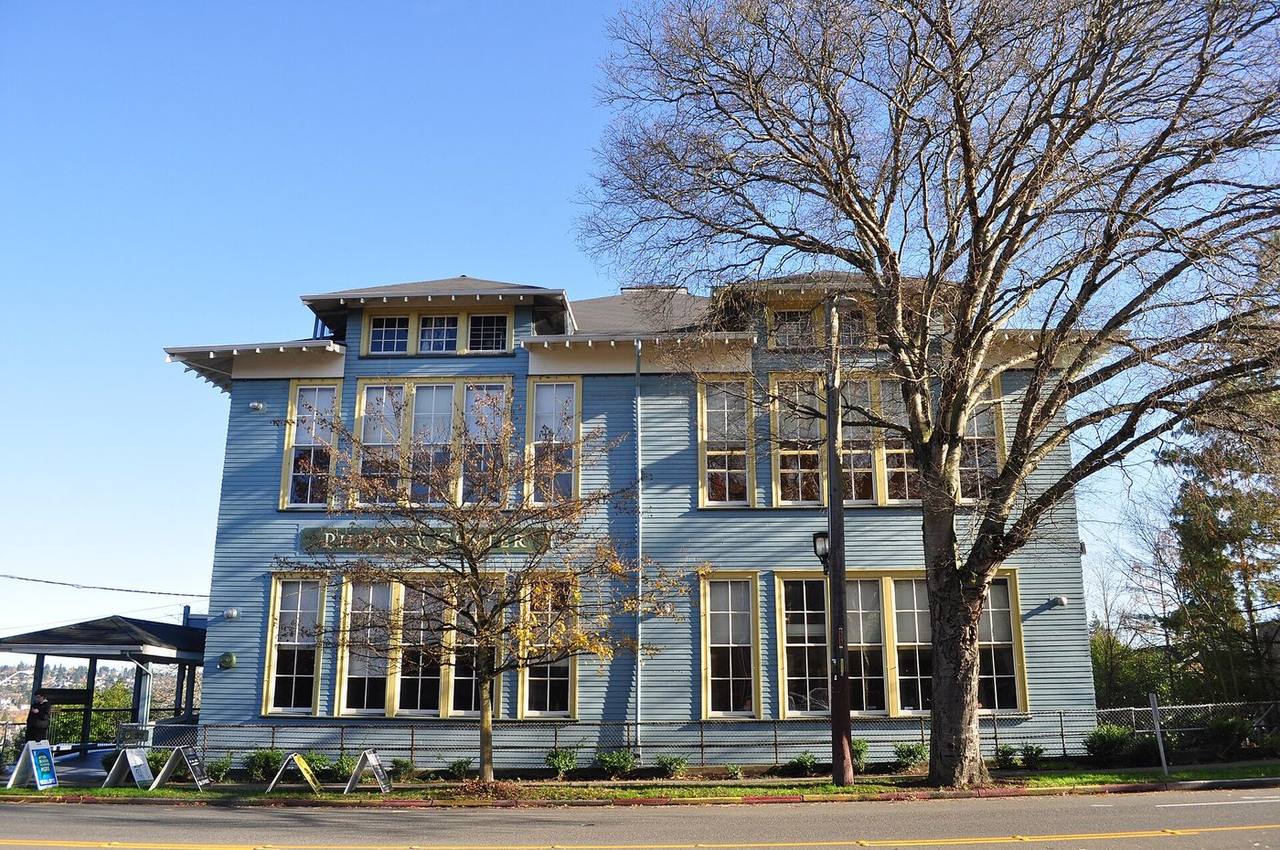
Woodland Park and the 92-acre Woodland Park Zoo anchor the neighborhood's southeast side. The main commercial spine runs along Phinney Avenue N south of about N 67th Street and continues north as Greenwood Avenue N, a corridor lined with locally owned shops, restaurants, and services. The Phinney Neighborhood Association operates a community center in the former John B. Allen Elementary School building, which opened in 1904 and has housed the association's programs since 1981.
For transit, King County Metro Route 5 runs along Phinney and Greenwood Avenues toward downtown Seattle, and the RapidRide E Line operates along Aurora Avenue N on the eastern boundary. The neighborhood is served by Seattle Public Schools; per the district, addresses here feed to Hamilton International Middle School and Ballard High School, with elementary assignment varying by address between schools such as B.F. Day and West Woodland. Confirm any address using the Seattle Public Schools Find Your School / Address Lookup tool, since attendance boundaries change.
What buyers & sellers weigh in Phinney Ridge
- Many homes date to roughly 1900-1915; budget for inspections of foundations, wiring, plumbing, and sewer lines.
- The western slope is steep in places; check whether a lot falls within Seattle's Environmentally Critical Areas (steep-slope) regulations before buying or building.
- Easternmost blocks border Aurora Avenue N (SR 99); factor potential traffic noise into pricing and showings.
- Ridge-top glacial-till ground is generally associated with lower liquefaction hazard, but verify each address on the city's geologic-hazard map.
- Lot topography and views vary widely across the ridge, which can create meaningful price differences block to block.
- Older Craftsman detail is a selling point for many buyers; sellers should document any updates to systems and seismic retrofits.
- School attendance areas are set by Seattle Public Schools and can change; verify assignment by address rather than by neighborhood name.
What makes Phinney Ridge distinct
- A ridge-top setting between Ballard and Green Lake, with elevation and views that distinguish it from the flatter neighborhoods on either side.
- Direct adjacency to Woodland Park and Woodland Park Zoo on the southeast edge.
- A walkable Phinney/Greenwood Avenue business corridor of locally owned shops and restaurants.
- A concentration of early-1900s streetcar-era Craftsman housing stock.
- A long-running community hub in the historic John B. Allen School building run by the Phinney Neighborhood Association.
Services in Phinney Ridge
Phinney Ridge real estate FAQ
What kinds of homes are common on Phinney Ridge?
The neighborhood retains many houses from the early 1900s, with the Craftsman bungalow a common style across North Seattle. You will also find later 20th-century houses and some newer townhomes and multifamily buildings, especially along the commercial corridors. Henos Adhana can help you compare specific homes and their condition.
Which school district serves Phinney Ridge?
Phinney Ridge is served by Seattle Public Schools. Per the district, addresses in the area feed to Hamilton International Middle School and Ballard High School, with elementary assignment varying by address. Because boundaries change, confirm the exact schools for any address using the Seattle Public Schools Find Your School / Address Lookup tool.
Are there slope or geologic issues to know about here?
The ridge is elevated and largely glacial till, which the city associates with lower liquefaction hazard, but the western slope is steep in places and some blocks are very steep. Steep parcels can fall under Seattle's Environmentally Critical Areas rules, so it is worth checking a specific address against the city's ECA and geologic-hazard maps before you buy or list.
How do people get around from Phinney Ridge?
King County Metro Route 5 runs along Phinney and Greenwood Avenues toward downtown Seattle, and the RapidRide E Line operates on Aurora Avenue N along the neighborhood's eastern edge. Many errands along the Phinney and Greenwood corridor are walkable from nearby homes.
Sources & data
- Phinney Ridge, Seattle - Wikipedia (boundaries, history, topography, business district)
- HistoryLink - Seattle Neighborhoods: Phinney Thumbnail History
- Woodland Park Zoo (official site)
- Phinney Neighborhood Association - PNA History (John B. Allen School, 1904)
- King County Metro - RapidRide E Line (Aurora Ave N)
- Seattle Transit Blog - Route 5 (Phinney/Greenwood Ave to downtown)
- Seattle Public Schools - Find Your School / Address Lookup
- Hamilton International Middle School - Seattle Public Schools
- Seattle SDCI - Updated Liquefaction-Prone Area Map (ECA)
- Seattle GeoData - ECA Liquefaction Prone Areas