

Lake City market snapshot
Over the trailing twelve months, the median Lake City home sold for about $1,112,500, up 0.1% from a year earlier. Homes here typically went under contract in about 7 days at roughly 100.0% of list price (around $561/sq ft), reflecting a brisk, seller-leaning market. These rolling 12-month figures come from the Northwest Multiple Listing Service, the regional MLS Seattle-area agents list on, as of June 2026, and cover the broader market area around Lake City rather than Lake City on its own, so for any specific home it is worth comparing recent sales on that block.
About Lake City
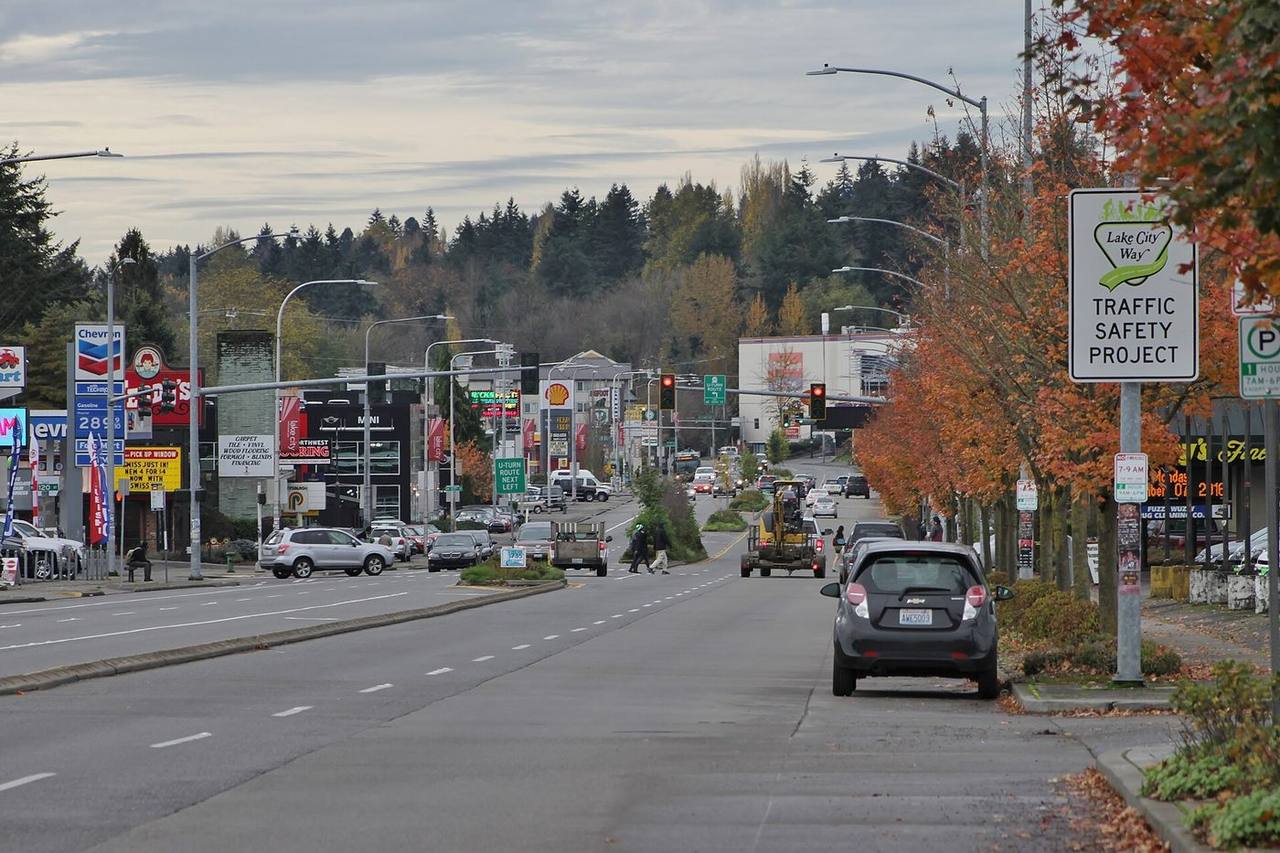
Lake City is a neighborhood in the northeast corner of Seattle, roughly 7 to 8 miles northeast of downtown and centered on Lake City Way NE, which is also State Route 522. A broad definition of the area runs from 15th Avenue NE east toward Lake Washington and from around NE 95th Street north to the city limits at NE 145th Street, taking in much of the Thornton Creek watershed.
The area was named Lake City in 1906 by D.H. and R.H. Lee after they platted the land, incorporated as a township in 1949, and was annexed into Seattle in 1954. Because it grew up along highways in the automobile era rather than around streetcar stops, Lake City has a linear, corridor-oriented layout, with a commercial spine along Lake City Way NE and residential streets fanning out to either side.
Want to know what your money actually buys in Lake City right now?
Book a 30-minute buying callHousing & homes
Much of Lake City's single-family housing dates to the mid-twentieth-century suburban growth that followed World War II, when the area filled in rapidly before and after annexation. As a result you will find a large share of postwar and mid-century homes, alongside earlier plats and later infill on the smaller residential streets.
Closer to the Lake City Way NE corridor and within the neighborhood's designated urban village, the housing mix broadens considerably. Seattle's Mandatory Housing Affordability program applied upzones here, and zoning in and near the urban village supports townhouses, rowhouses, stacked flats, cottages, and low-rise apartments in addition to detached houses. Expect a spectrum of property types, from older single-family homes on interior streets to newer attached and multifamily construction near the corridor.
Local conditions to know
Lake City sits within the Thornton Creek watershed, the largest in Seattle at about 12 square miles. Stormwater and flooding have been recurring issues in the watershed, where much of the creek and its tributaries have been straightened and adjacent wetlands filled over the decades. If you are considering a property near Thornton Creek, Little Brook Creek, or a low-lying drainage, review its location relative to the creek system, drainage patterns, and any critical-area designations; the city has active drainage and floodplain projects in the area, including the Lake City Floodplain Park, intended to reconnect floodplain and manage flood flows along the creek.
Transit access is changing here. Sound Transit's NE 130th Street station, named Pinehurst, on the 1 Line is scheduled to open in 2026 just west of Lake City, and King County Metro's restructured east-west routes, including Route 77 along N 130th Street, are designed to connect Lake City neighborhoods to that station. Verify current service and walking distance for any specific address rather than assuming corridor-wide access.
Getting around & local texture
The neighborhood's commercial life concentrates along Lake City Way NE, the district that has served as its main street since the corridor was first paved in the early twentieth century. Nearby community anchors include the Lake City Community Center, the Lake City branch of the Seattle Public Library, and the Lake City Farmers Market, along with neighborhood parks such as Little Brook Park, Virgil Flaim Park, Albert Davis Park, and the Lake City Mini Park. The broader Lake City area also encompasses sub-neighborhoods including Cedar Park, Matthews Beach, Meadowbrook, Olympic Hills, and Victory Heights.
Lake City is within the Seattle Public Schools district. Attendance-area boundaries, option-school geozones, and transportation areas are set by the district and can change; confirm the assigned schools for any specific address using the district's official enrollment maps before relying on them.
What buyers & sellers weigh in Lake City
- The neighborhood mixes older single-family homes with newer townhouses, rowhouses, and low-rise apartments, so comparable sales should match the property type you are buying or selling.
- For properties near Thornton Creek or its tributaries, review drainage, floodplain, and any critical-area designations early in the process.
- Confirm proximity and walk time to the future NE 130th Street (Pinehurst) light rail station and connecting bus routes for the exact address, not the corridor generally.
- Verify current zoning within or outside the Lake City urban village, since it affects what can be built or added on a given lot.
- Seattle Public Schools attendance boundaries are set by the district and can change; confirm assigned schools per address.
- Because the neighborhood spans several sub-areas from Cedar Park to Victory Heights, define the exact geography when comparing listings.
What makes Lake City distinct
- Lake City centers on the Lake City Way NE (SR-522) commercial corridor rather than a single downtown grid, reflecting its automobile-era origins.
- The area was an independent township annexed into Seattle in 1954, giving it a distinct suburban development history compared with older streetcar neighborhoods.
- It contains much of the Thornton Creek watershed, Seattle's largest, which shapes drainage and open-space projects across the neighborhood.
- The upcoming NE 130th Street (Pinehurst) light rail station and restructured east-west bus routes are reshaping transit access on the neighborhood's edge.
- Urban-village upzoning has layered townhouses, rowhouses, and low-rise apartments onto a formerly single-family fabric near the corridor.
Services in Lake City
Lake City real estate FAQ
Where is Lake City in Seattle?
Lake City is in the northeast corner of Seattle, about 7 to 8 miles northeast of downtown, centered on Lake City Way NE (State Route 522). The broader area runs from roughly 15th Avenue NE toward Lake Washington and from around NE 95th Street to the city limits at NE 145th Street.
What kinds of homes are in Lake City?
The neighborhood has a large share of mid-twentieth-century single-family homes on its interior streets, plus newer townhouses, rowhouses, stacked flats, and low-rise apartments near the Lake City Way NE corridor and urban village, where zoning supports more housing types.
Will light rail serve Lake City?
Sound Transit's NE 130th Street station, named Pinehurst, on the 1 Line is scheduled to open in 2026 just west of Lake City, and King County Metro has restructured east-west bus routes, including Route 77 on N 130th Street, to connect Lake City neighborhoods to it. Confirm service and distance for a specific address.
What school district serves Lake City?
Lake City is within the Seattle Public Schools district. Attendance-area boundaries and option-school geozones are set by the district and can change, so confirm the assigned schools for a specific address using the district's official enrollment maps.
Sources & data
- Lake City, Seattle - Wikipedia
- Seattle Neighborhoods: Lake City -- Thumbnail History - HistoryLink.org
- Thornton Creek watershed flooding - Lake City Floodplain Park Project Background
- Lake City Floodplain Park - Seattle Public Utilities
- Little Brook Park - Seattle Parks & Recreation
- Lake City Community Center - Seattle Parks & Recreation
- NE 130th Street (Pinehurst) station and Metro restructure - Sound Transit / King County Metro Lynnwood Link Connections
- Lynnwood Link extension (NE 130th / Pinehurst station) - Wikipedia
- Seattle City Council MHA urban-village upzones (Lake City) - Foster Garvey
- Seattle Public Schools - Enrollment maps and attendance areas