
Greenwood market snapshot
Over the trailing twelve months, the median Greenwood home sold for about $980,000, up 2.1% from a year earlier. Homes here typically went under contract in about 7 days at roughly 100.0% of list price (around $571/sq ft), reflecting a brisk, seller-leaning market. These rolling 12-month figures come from the Northwest Multiple Listing Service, the regional MLS Seattle-area agents list on, as of June 2026, and cover the broader market area around Greenwood rather than Greenwood on its own, so for any specific home it is worth comparing recent sales on that block.
About Greenwood
Greenwood is a residential neighborhood in north-central Seattle. Its generally accepted boundaries are Aurora Avenue N (State Route 99) on the east, N 105th Street/Holman Road on the north, 8th Avenue NW on the west, and N 75th Street on the south, beyond which lies Phinney Ridge; the two neighborhoods share business-district events and their boundary is loosely drawn. Adjacent neighborhoods include Licton Springs to the east and Crown Hill to the west. The area spans ZIP codes 98103, 98117, and 98133.
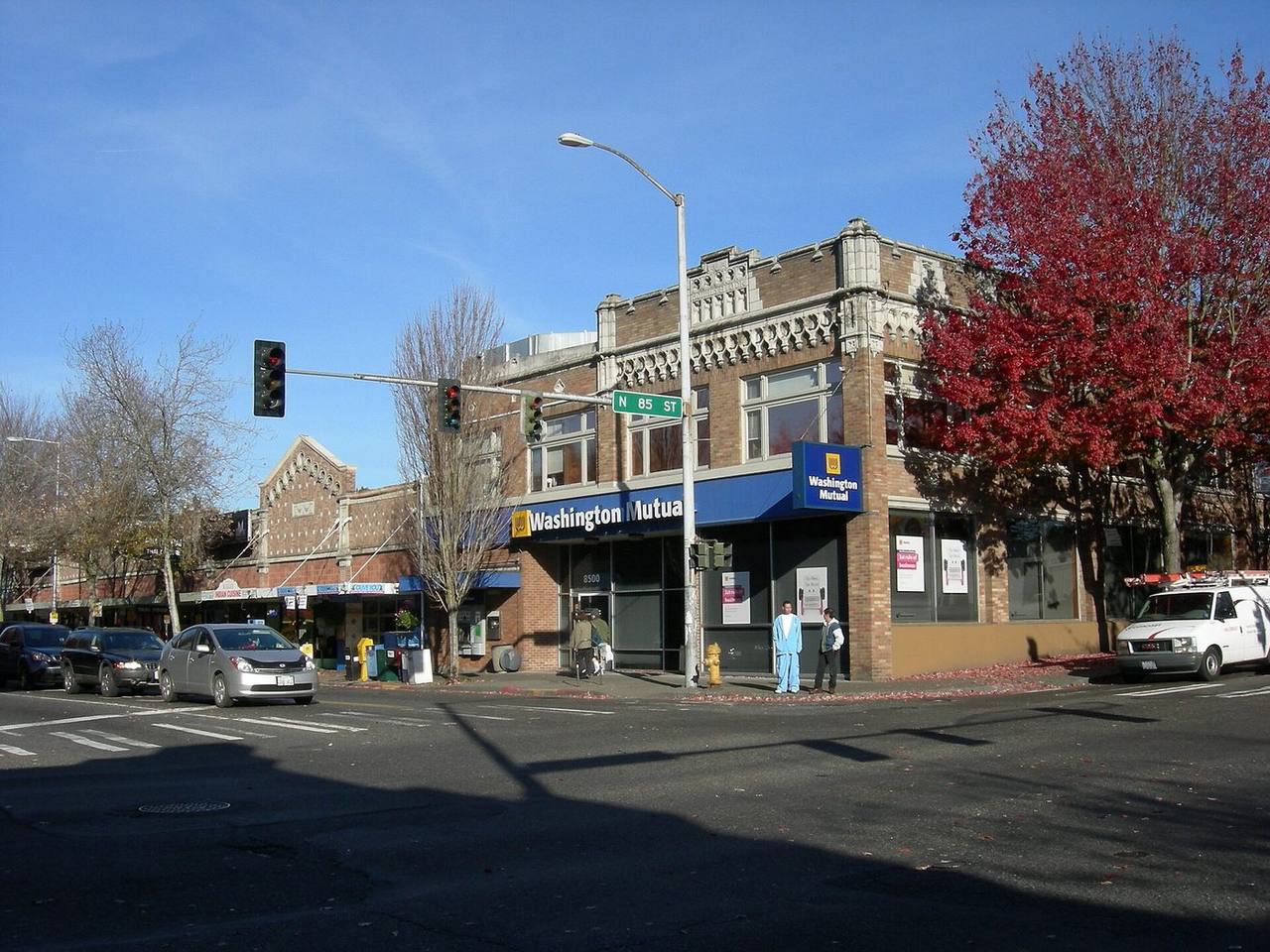
The neighborhood was originally called Woodland and was renamed Greenwood in 1907. Streetcar and Seattle-Everett interurban rail once ran along Greenwood Avenue, and the section north of N 85th Street was annexed to Seattle in 1954. Today the intersection of Greenwood Avenue N and N 85th Street functions as the commercial center.
Want to know what your money actually buys in Greenwood right now?
Book a call and I'll tell you what I'd doHousing & homes
Greenwood's residential fabric took shape largely in the first half of the 20th century, and the neighborhood's housing reflects that era. You'll find a mix of Craftsman-influenced bungalows and other early-century single-family houses on the residential streets, alongside later infill.
Along and near Greenwood Avenue N, the commercial district is anchored by brick and stone storefronts built in the 1920s and into the early 1930s, many of which survive. Property types in the neighborhood range from detached single-family homes to townhomes and small multifamily and mixed-use buildings clustered near the Greenwood Avenue and N 85th Street corridors.
Local conditions to know
Greenwood's most distinctive physical characteristic is its geology: the heart of the neighborhood sits atop a peat deposit, a former bog that formed in a bowl shape after glacial retreat. When groundwater is drawn down, peat compresses irreversibly, which has caused documented settlement of some streets, sidewalks, and structures in and around the business district and the residential blocks north and west of Greenwood Avenue N and N 85th Street. In 2008 the City of Seattle added peat bogs to its Environmentally Critical Areas (ECA) framework, which can trigger geotechnical evaluation for major construction, and in 2012 the city rebuilt N 85th Street and repaved much of Greenwood Avenue N while repairing settlement-related sidewalk damage. Portions of the area also fall within the city's mapped liquefaction-prone ECA, which the Seattle Department of Construction and Inspections updated under Director's Rule 2-2023 (effective August 2023).
The neighborhood's eastern edge is Aurora Avenue N (State Route 99), a major arterial. Buyers weighing specific parcels should confirm ECA overlays and any geotechnical or foundation history through the City of Seattle's official maps and permit records.
Getting around & local texture
The intersection of Greenwood Avenue N and N 85th Street is the heart of the neighborhood and its business district, part of a corridor that hosts recurring events such as a spring art walk and a summer classic-car show. The Seattle Public Library has operated a Greenwood branch since 1928; the current building at 8016 Greenwood Ave N opened in 2005 and was renovated in 2017. City-maintained parks in the neighborhood include Greenwood Park, Sandel Park, and Alice Ball Park.
Greenwood is within the Seattle Public Schools district; Greenwood Elementary School, part of Seattle Public Schools, is located at 144 NW 80th St. Because attendance boundaries are set by the district and can change, verify the assigned attendance area for any specific address using Seattle Public Schools' official address-lookup tool. For transit, Aurora Avenue N along the neighborhood's eastern edge carries King County Metro's RapidRide E Line between Shoreline and downtown Seattle, and Metro Route 5 provides local service through Greenwood toward Fremont and downtown.
What buyers & sellers weigh in Greenwood
- Order a geotechnical review and ask for any foundation, settlement, or drainage history; peat soils underlie much of the neighborhood and can compress when groundwater drops.
- Confirm whether a parcel falls within a mapped Environmentally Critical Area (peat/bog or liquefaction-prone) using the City of Seattle's official ECA maps before removing contingencies.
- Review the age of the home's systems and foundation; much of the residential stock dates to the early 20th century.
- For homes near Aurora Avenue N (SR 99), factor in arterial traffic and noise when comparing parcels.
- Verify the assigned school attendance area by address through Seattle Public Schools, since boundaries can change.
- Sellers can strengthen a listing by assembling permit records, any prior geotechnical reports, and documentation of foundation or drainage work.
What makes Greenwood distinct
- Greenwood's peat-bog geology and the City's Environmentally Critical Area rules make soil and foundation due diligence more central here than in many neighboring areas.
- A dense, walkable commercial core at Greenwood Avenue N and N 85th Street with early-1900s brick storefronts and a shared business district with Phinney Ridge.
- Direct access to Aurora Avenue N (SR 99) with frequent RapidRide E Line service, plus local Metro Route 5 through the neighborhood.
- An early-20th-century streetcar-era street grid and housing stock, with a portion of the area annexed to Seattle only in 1954.
- Three city-maintained parks (Greenwood, Sandel, and Alice Ball) and a long-standing Seattle Public Library branch within the neighborhood.
Services in Greenwood
Greenwood real estate FAQ
Why does soil condition come up so often when buying in Greenwood?
Much of Greenwood sits atop a peat deposit, a former bog. Peat can compress when groundwater is drawn down, and the neighborhood has documented settlement of some streets, sidewalks, and structures. The City of Seattle includes peat bogs in its Environmentally Critical Areas framework, which can require geotechnical evaluation for major construction. A geotechnical review and a look at any foundation history are worth building into your due diligence.
What school district serves Greenwood?
Greenwood is within Seattle Public Schools. Greenwood Elementary School, part of Seattle Public Schools, is at 144 NW 80th St. Attendance boundaries are set by the district and can change, so confirm the assigned attendance area for a specific address using the district's official address-lookup tool.
How do people get around from Greenwood?
Aurora Avenue N (State Route 99) runs along the neighborhood's eastern edge and carries King County Metro's RapidRide E Line between Shoreline and downtown Seattle. Metro Route 5 provides local service through Greenwood toward Fremont and downtown.
Sources & data
- Greenwood, Seattle - Wikipedia
- HistoryLink.org - Seattle Neighborhoods: Greenwood Thumbnail History
- Seattle DCI / Building Connections - Updated Liquefaction-Prone Area Map (Director's Rule 2-2023)
- ECA Liquefaction Prone Areas - Seattle GeoData
- The Seattle Public Library - Greenwood Branch
- Greenwood Elementary School - Seattle Public Schools
- Seattle Public Schools - Enrollment maps and address lookup
- RapidRide E Line - Wikipedia
- King County Metro Route 5 - Transit App